Dealing With Damage Right Now?
Phase III Construction responds 24/7 across SE Michigan. Licensed Builder. BBB A+.
☎ Call (734) 237-7322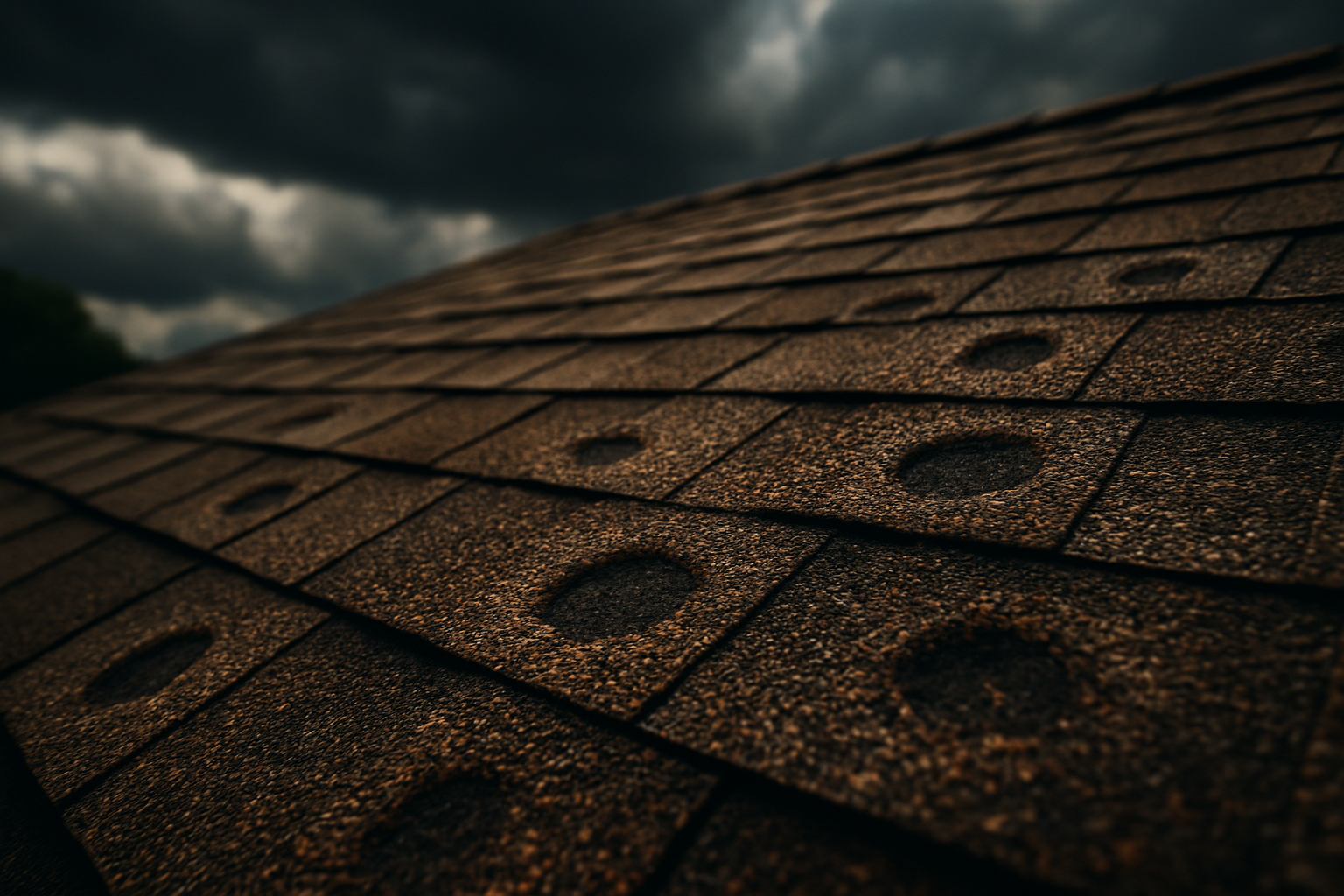
SE Michigan Hail Season: What Every Homeowner Needs to Know
Southeast Michigan sits in one of the most active hail corridors in the Midwest. Every spring and summer, storms roll through Wayne, Oakland, Washtenaw, and Livingston Counties leaving cracked shingles, dented gutters, and damaged siding in their wake. Most homeowners never find out the full extent of the damage — because they never knew what to look for, or they waited too long to act.
This guide covers everything you need to know: when hail season peaks, how to identify damage, what your insurance policy actually covers, and exactly how to protect your claim from the moment a storm passes.
When Is Hail Season in Southeast Michigan?
Michigan’s hail season runs from April through September, with the highest frequency of significant hail events concentrated in May, June, and July. Storms typically develop along cold fronts moving through the Great Lakes region and can produce hail ranging from pea-sized (0.25″) to baseball-sized (2.75″+) in severe events.
Even modest hail — marble to quarter-sized (0.75″ to 1.0″) — is large enough to cause functional damage to asphalt shingles, aluminum gutters, siding, and HVAC equipment. That damage may not be visible from the ground. It may not leak for weeks or months. But the granule loss and membrane bruising are there — and your insurance policy covers it.
Notable SE Michigan Hail Events (Recent History)
- June–July 2023: Multiple severe hail events across Oakland and Macomb Counties — 1.0″–1.75″ hail widespread
- August 2023: Wayne County storm — quarter to golf ball hail along the I-275 corridor
- May 2024: Washtenaw and Livingston County outbreak — widespread shingle damage across Saline, Brighton, and Howell
- Summer 2025: Back-to-back storm events across SE Michigan generating record supplement volume
What Does Hail Actually Do to Your Home?
Hail damage is not always obvious — and insurance companies know that. Here’s what to look for on each component of your home:
Roof (Asphalt Shingles)
The most critical and most commonly missed. Hail impacts cause:
- Granule loss — the protective coating is knocked off, exposing the asphalt mat underneath
- Bruising — soft spots in the shingle mat that crack under thermal expansion over time
- Cracking — direct punctures or fractures in the shingle surface
- Seal strip damage — hail can break the factory adhesive seal, creating wind uplift vulnerability
A shingle roof with hail damage will fail prematurely — typically within 3–7 years of impact. By then, your claim window may be closed.
Gutters and Downspouts
Aluminum gutters are one of the clearest indicators of hail impact. Look for circular dents (called “spatter”) on the face of the gutter. Each dent represents a direct hail hit — and if your gutters show it, your roof does too.
Siding (Vinyl, Aluminum, Wood)
- Vinyl: Cracks, chips, and fractures — especially on south and west-facing elevations
- Aluminum: Circular dents, similar to gutters
- Wood: Splits, splinters, and paint damage at impact points
Window Screens, Trim, and Fascia
Aluminum window screens, J-channel trim, and painted fascia boards all show hail impact clearly. These are often the easiest evidence to document and photograph.
HVAC Equipment
Air conditioner condenser fins are extremely vulnerable to hail. Even small hail can bend fins and reduce efficiency. Replacement is a legitimate claim item — and one carriers frequently try to omit.
Does Your Homeowner’s Policy Cover Hail Damage?
In Michigan, standard homeowner’s insurance policies (HO-3 and HO-5 forms) cover hail damage under the dwelling coverage (Coverage A) as a named peril. This means:
- Your roof, siding, gutters, windows, and HVAC are covered for sudden and accidental hail damage
- Coverage applies to the full replacement cost value (RCV) of damaged components — not just the depreciated cash value — on most modern policies
- You are entitled to like-kind-and-quality replacement — not a patch on a mismatched roof
What Carriers Often Try to Limit
- Cosmetic damage exclusions — some policies exclude denting on metal surfaces that doesn’t affect function. Read your policy language carefully.
- Matching disputes — when one slope is damaged, carriers often refuse to replace the full roof. Michigan law and standard policy language typically support full replacement for aesthetic consistency.
- Age and depreciation — carriers will apply heavy depreciation to older roofs. A proper supplement can recover that depreciation upon documented completion.
- ACV-only policies — some policies (especially older ones) pay only actual cash value, not replacement cost. Know your policy before the storm hits.
What To Do Immediately After a Hail Storm
Step 1: Document Before Anything Is Disturbed
Before anyone gets on your roof or touches your property, photograph everything you can safely access from the ground. Focus on:
- Gutters — photograph dents on the face and inside the gutter trough
- Window screens and trim — visible spatter marks
- AC unit — fin damage visible from the side
- Any cracked or missing siding panels
- Any visible roof damage from ground level
Step 2: Call Phase III — Not Your Insurance Company First
This is critical. Once you file a claim, the clock starts. An insurance adjuster will be dispatched — and their job is to minimize what they pay. Before that adjuster arrives, you want a trained restoration contractor on-site who knows exactly what to document and what the policy covers.
Phase III conducts a forensic damage assessment before any adjuster visit. We document every impacted component with photos, measurements, and scope notes — so when the adjuster arrives, there is no question about what happened and what needs to be replaced.
Step 3: File Your Claim
Call your insurance carrier and file the claim. Provide the date of loss (the storm date — check weather records if needed), describe the damage generally, and request an adjuster inspection. Do not accept a settlement or sign anything until Phase III has reviewed the adjuster’s estimate.
Step 4: Do Not Make Permanent Repairs Yet
Emergency tarping or board-up to prevent further damage is appropriate and covered. But do not replace your roof, siding, or gutters before the adjuster has inspected and before Phase III has confirmed the scope is complete. Premature repairs can forfeit your claim rights.
Step 5: Review the Adjuster’s Estimate — With Us
Insurance adjusters routinely miss line items, underpay labor rates, omit code-required upgrades, and skip components that aren’t obviously visible. Phase III reviews every adjuster estimate against the actual damage scope. If it’s short — and it usually is — we supplement the claim with documented evidence until the number is right.
Michigan Hail Claim Deadlines
Michigan homeowner’s policies typically require you to file a claim within one year of the date of loss, though some policies allow up to two years. The longer you wait:
- The harder it is to prove the damage was storm-related (weathering arguments from the carrier)
- The more secondary damage accumulates (water intrusion, mold, structural deterioration)
- The weaker your negotiating position becomes
If you had a storm come through and you haven’t had your roof inspected — call us today. An inspection costs you nothing and tells you exactly where you stand.
Why SE Michigan Homeowners Choose Phase III
Phase III Construction has handled hail claims across Wayne, Oakland, Washtenaw, and Livingston Counties for over 30 years. We know Michigan carriers, we know Michigan adjusters, and we know exactly what your policy owes you.
- No-cost storm damage inspection — we get on your roof and document everything
- Claim management from filing to final payment — you don’t deal with the adjuster alone
- Supplement expertise — we challenge low estimates and fight for every line item
- Michigan Builders License #262000615 — fully licensed, bonded, and insured
- BBB A+ rated — accountable to the community we serve
When a storm hits, you have one shot to get your claim right. Phase III makes sure you don’t leave money on the table.
Call (734) 237-7322 or request your inspection below.
Phase III Construction handles hail & storm damage restoration for homeowners across SE Michigan. Michigan Builders License #262000615. We work directly with your insurance company and fight your claim from start to finish. Get an inspection →
Ready to Rebuild Now?
Call Phase III Construction today — we handle the insurance battle so you don't have to.
Get Your InspectionPART OF THE HAIL & STORM GUIDE
This article is part of Phase III's complete Hail & Storm resource series.
← Back to the complete Hail & Storm guide: Storm Damage Insurance Claims in Michigan: What Carriers Look For